
Online Predictive Astrology Course 2026 – New Batch Starting 14 November
Learn Practical Vedic Astrology Prediction Techniques with Centre of Astrology
New Batch Starts: Saturday, 14 November 2026
Mode: Online Classes | Instructor: Chhatraveer Singh Gahlot, Astrologer & Vastu Consultant
Table of Contents
Are you looking for an Online Predictive Astrology Course that helps you understand how astrologers analyse Kundlis, interpret planetary periods, study Nakshatras, and assess important life events through traditional predictive techniques?
Do you already understand the basics of Vedic Astrology but find it difficult to connect different planetary combinations while interpreting a horoscope?
Or are you interested in studying advanced astrology methods such as Dasha Analysis, Nakshatra Nadi, Prashna Kundli, Sub-lord Analysis, and Stellar Astrology?
Centre of Astrology, Dehradun, announces its new Online Predictive Astrology Course 2026 batch, starting on Saturday, 14 November 2026.
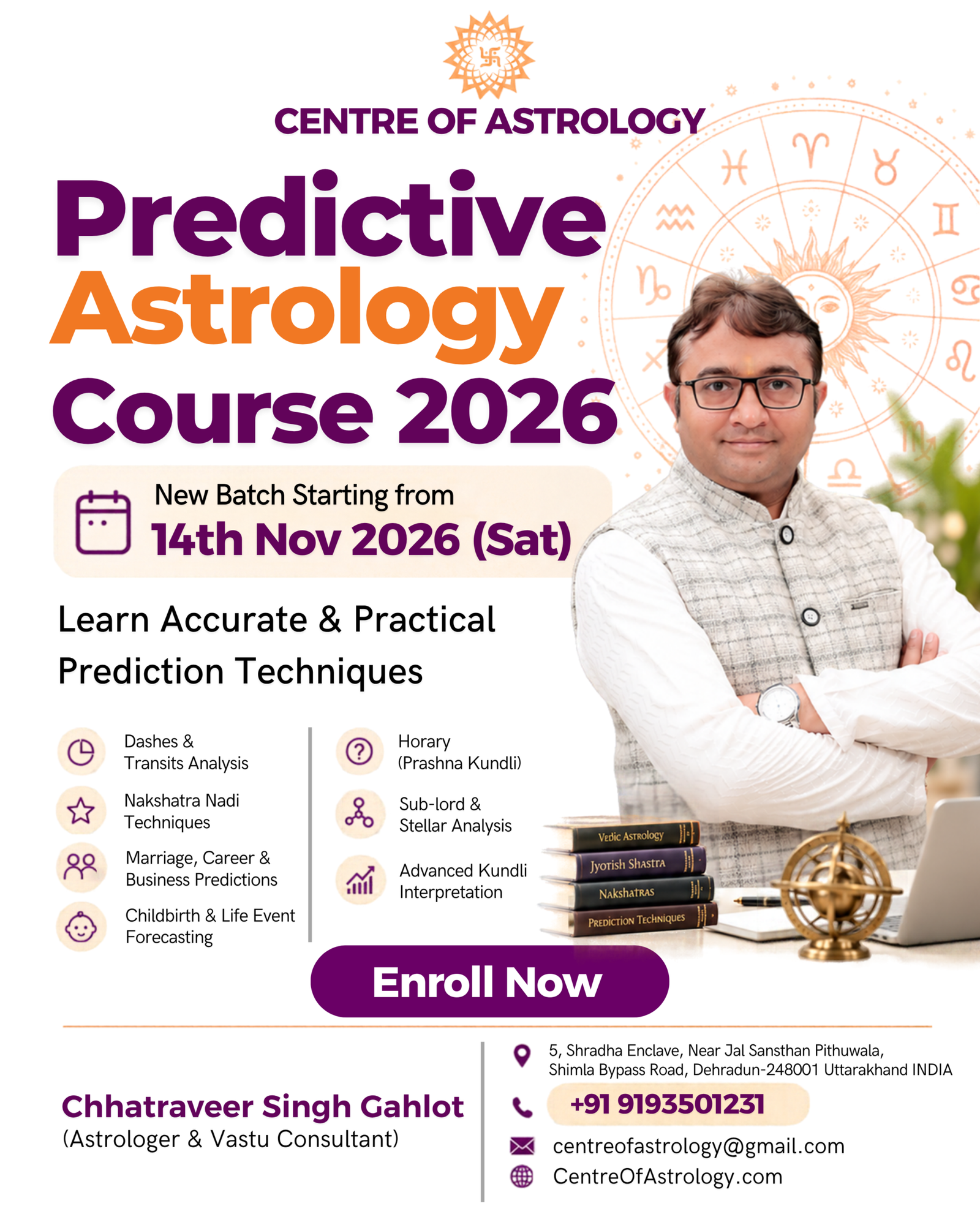
Conducted under the guidance of Chhatraveer Singh Gahlot, Astrologer & Vastu Consultant, this course brings together important traditional astrological techniques used in horoscope interpretation and predictive analysis.
The programme is designed for astrology students, enthusiasts, and practitioners interested in moving beyond isolated astrological rules towards a more systematic understanding of birth-chart interpretation.
The course covers:
- Dashas & Transits Analysis
- Nakshatra Nadi Techniques
- Marriage, Career & Business Predictions
- Childbirth & Life Event Forecasting
- Horary Astrology (Prashna Kundli)
- Sub-lord & Stellar Analysis
- Advanced Kundli Interpretation
The objective is to help students understand how different astrological methods relate to one another and how practitioners traditionally use them when examining horoscope combinations and event timing.
New Batch Starting 14 November 2026 – Enrol Now
Online Predictive Astrology Course 2026
Batch Commencement: Saturday, 14 November 2026
Instructor: Chhatraveer Singh Gahlot
Institute: Centre of Astrology, Dehradun
Interested in joining the upcoming batch?
Contact Centre of Astrology for course fees, class timings, enrolment requirements, and the latest batch information.
Call / WhatsApp: +91 9193501231
Email: centreofastrology@gmail.com
Website: CentreOfAstrology.com
What Is Predictive Astrology and Why Should You Study It?
Predictive Astrology is a specialised area of traditional astrology concerned with interpreting planetary positions, periods, movements, and combinations in relation to events and developments in a person’s life.
In Vedic Astrology, the birth chart or Janam Kundli forms the foundation of interpretation.
However, understanding the twelve houses, nine Grahas, zodiac signs, and planetary aspects is only the beginning.
A student who wishes to study predictive techniques must learn how multiple factors are examined together.
For example, when analysing career-related questions, an astrologer may consider the tenth house, its lord, relevant planetary significators, ongoing Dashas, planetary transits, and additional chart factors.
Similarly, traditional marriage-related analysis may involve the seventh house, its lord, Venus, Jupiter, relevant divisional charts, and planetary periods.
Different schools of astrology may interpret these combinations differently.
Predictive astrology training helps students understand the principles behind such methods, compare interpretive approaches, and study how astrologers arrive at their conclusions.
An important distinction: Astrology is a traditional belief-based interpretive discipline. Its ability to predict future events accurately has not been established by scientific evidence. This course teaches the concepts and methods used within astrological traditions.
Why Learning Astrology Prediction Techniques Requires More Than Memorising Rules
One of the common challenges for astrology students is moving from theoretical knowledge to practical chart interpretation.
A learner may understand that the tenth house relates to profession or that the seventh house is associated with marriage. However, actual horoscope interpretation within traditional astrology involves many interconnected factors.
A single house or planetary placement does not represent the entire chart.
Students must understand how to evaluate planetary rulership, house relationships, planetary strength, Dasha periods, transits, Nakshatras, and other relevant techniques.
Consider three examples.
Example 1: Career-related interpretation
A student is examining a chart for a question about professional change.
Instead of relying only on the tenth house, a traditional astrologer may consider the sixth house, tenth house, eleventh house, relevant planetary significators, current Mahadasha and Antardasha, and transits.
Example 2: Marriage-related interpretation
A student examining marriage-related questions may study the seventh house, its lord, Venus, Jupiter, the Navamsa chart, and planetary periods.
Example 3: A question without complete birth details
When accurate birth information is unavailable, an astrologer may study a Prashna Kundli, using a question-based chart constructed according to the chosen horary system.
These are illustrative learning scenarios, not verified examples of successful predictions.
The purpose of practical predictive astrology education is to understand how such frameworks are used and how interpretations can be examined critically.
Complete Online Predictive Astrology Course Curriculum
Module 1: Dashas & Transits Analysis
Learn the traditional principles of planetary periods and planetary movements.
Dasha systems are central to many methods of Vedic predictive astrology.
A Dasha represents a planetary period that astrologers associate with particular themes, experiences, and possible developments according to the birth chart.
The Vimshottari Dasha system is among the most widely studied systems in Vedic Astrology.
Students studying Dasha analysis explore how Mahadasha and Antardasha periods are interpreted in relation to planetary placement, ownership, strength, aspects, and other chart factors.
Important concepts include:
- Mahadasha and Antardasha interpretation
- Planetary rulership and house ownership
- Functional benefic and malefic considerations
- Planetary strength and relationships
- The relationship between Dasha periods and house significations
- Combining Dasha interpretation with other chart factors
Understanding Planetary Transits
Planetary transit analysis, also called Gochara, examines the movement of planets through the zodiac.
In traditional astrology, transits of Jupiter, Saturn, Rahu, Ketu, and other planets are considered alongside the natal horoscope.
A transit alone may be interpreted differently depending on the natal chart, the ongoing planetary period, and the astrological system being followed.
The learning objective is to understand how astrologers examine planetary timing systems together instead of treating each planetary movement as an isolated indicator.
Module 2: Nakshatra Nadi Techniques
Explore the role of Nakshatras in specialised astrological interpretation.
Nakshatras form an important part of the traditional Vedic astrological framework.
The zodiac is divided into 27 Nakshatras, each spanning 13 degrees and 20 minutes.
Every Nakshatra has its own traditional characteristics, ruling planet, and symbolic associations.
Nakshatra-based interpretation adds another layer to the study of planetary positions.
Students exploring Nakshatra Nadi techniques encounter concepts related to planetary connections, Nakshatra rulership, significations, and specialised interpretive methods.
Important areas of study include:
- The role of Nakshatras in Vedic Astrology
- Nakshatra lords and their significations
- Planetary placement within Nakshatras
- Relationships between planets and Nakshatra rulers
- Nakshatra-based approaches to chart interpretation
- Understanding how specialised Nadi traditions differ from general horoscope reading
Different Nadi schools use different methods, so students should understand which specific approach is being taught rather than assuming all Nadi techniques are identical.
Module 3: Marriage, Career & Business Predictions
Study traditional horoscope interpretations relating to important personal and professional decisions.
Marriage, employment, career development, and business are frequently discussed in astrology consultations.
This module explores the astrological houses, planetary combinations, and interpretive methods traditionally associated with these subjects.
Marriage and Relationship Astrology
In traditional Vedic Astrology, marriage-related interpretation commonly involves the seventh house, its lord, Venus, Jupiter, the Navamsa chart, and relevant planetary periods.
Students explore how astrologers study these indicators together when considering relationship-related questions.
Topics may include relationship significations, traditional marriage timing methods, and the interaction between planetary periods and house relationships.
Astrological analysis should not replace communication, personal compatibility, or informed relationship decisions.
Career Prediction Techniques
Career-related astrology commonly examines the tenth house, sixth house, second house, eleventh house, and relevant planetary significators.
Students explore traditional methods of interpreting professional interests, employment-related themes, career transitions, and changes in responsibilities.
The module helps learners understand how different chart elements are considered together.
Business and Entrepreneurship Astrology
Business-related interpretation may involve the seventh, tenth, second, and eleventh houses, depending on the method followed.
Students explore traditional planetary significations associated with entrepreneurship, commercial activity, partnerships, and professional independence.
Such interpretations are educational and should never replace financial due diligence, professional advice, or business planning.
Module 4: Childbirth & Life Event Forecasting
Understand traditional methods of interpreting significant life events.
Childbirth and family-related questions are another area of traditional predictive astrology.
The fifth house, Jupiter, relevant divisional charts, planetary periods, and transits are among the factors that astrologers may study.
This module introduces the traditional principles used in interpreting such questions.
Students also explore broader approaches to life-event analysis, including how planetary periods and house relationships are considered when examining major transitions.
An important part of responsible astrology education is recognising the limitations of astrological interpretation.
Fertility, pregnancy, childbirth, and other medical matters require qualified healthcare advice. Astrology cannot reliably diagnose medical conditions or determine pregnancy outcomes.
Module 5: Horary Astrology – Prashna Kundli
Learn the principles of question-based horoscope interpretation.
Horary Astrology, known as Prashna Kundli in Indian astrology, is a system in which an astrological chart is prepared in relation to a specific question.
Unlike natal astrology, which relies primarily on birth details, Prashna astrology focuses on the circumstances and timing of the question.
This makes it a distinct branch of traditional astrological study.
Important concepts include:
- Introduction to Prashna Kundli
- Principles of constructing a horary chart
- The role of the ascendant and relevant houses
- Planetary significators
- Question-related house analysis
- Traditional judgement methods
- Comparing horary and natal approaches
For students interested in different methods of chart interpretation, Prashna Kundli provides an additional framework for study.
Module 6: Sub-lord & Stellar Analysis
Explore specialised techniques associated with stellar astrology and planetary sub-divisions.
Stellar astrology studies planetary relationships through Nakshatras and other subdivisions.
Sub-lord analysis is particularly associated with Krishnamurti Paddhati, commonly known as KP Astrology.
In KP methods, house cusps, star lords, sub-lords, and significators play important roles in interpretation.
Students exploring these concepts learn how planetary significations are examined through a more detailed subdivision-based approach.
Important areas include:
- Introduction to stellar astrology
- Nakshatra lords and planetary significators
- The concept of sub-lords
- House cusps and their interpretive role
- Planetary relationships within stellar frameworks
- Differences between conventional Vedic and KP-style approaches
This module is especially relevant to learners interested in understanding how different predictive systems organise and interpret astrological information.
Module 7: Advanced Kundli Interpretation
Bring multiple astrological techniques together in a structured analytical process.
Advanced horoscope interpretation requires more than understanding individual planets and houses.
Students must learn how to examine the birth chart as a connected system.
The Advanced Kundli Interpretation module focuses on integrating the major techniques introduced throughout the course.
A systematic approach may include:
- Identifying the relevant houses for the question.
- Examining house lords and planetary placements.
- Evaluating traditional planetary strength and relationships.
- Considering applicable divisional charts.
- Studying relevant Dasha and Antardasha periods.
- Reviewing planetary transits.
- Applying Nakshatra or stellar methods where appropriate.
- Comparing interpretations and recognising uncertainty.
The objective is to build a disciplined approach to traditional chart interpretation.
Rather than treating every planetary combination as a guaranteed outcome, students are encouraged to understand how different interpretive rules relate to one another.
Ready to Learn Predictive Astrology? Join the November 2026 Batch
Take the next step in your astrology learning journey.
If you want to study Dasha and Transit Analysis, Nakshatra Nadi Techniques, Marriage and Career Predictions, Prashna Kundli, Stellar Astrology, and Advanced Kundli Interpretation, enquire about the upcoming Online Predictive Astrology Course.
New Batch Starting: 14 November 2026 (Saturday)
CENTRE OF ASTROLOGY
Instructor: Chhatraveer Singh Gahlot
Astrologer & Vastu Consultant
Call / WhatsApp for Admission: +91 9193501231
Email: centreofastrology@gmail.com
Website: CentreOfAstrology.com
Enquire Now – Get Course Details and Admission Information
How to Interpret a Kundli Systematically: A Practical Learning Framework
One of the most valuable skills for an astrology student is developing a consistent process for examining a horoscope.
Without a structured approach, students may become overwhelmed by the number of astrological rules, combinations, and timing systems.
A systematic learning framework can help organise the analysis.
Step 1: Understand the Ascendant and House Structure
Begin with the Lagna or ascendant and identify the twelve houses.
Each house has traditional significations relating to different areas of life.
Understanding the overall house structure is essential before studying specialised predictive methods.
Step 2: Examine Planetary Placement and House Ownership
A planet’s interpretation depends on more than its natural significations.
Traditional Vedic methods also consider the houses it rules, the house it occupies, its relationships with other planets, and its condition in the chart.
Step 3: Identify Relevant Houses
The next step is to determine which houses are relevant to the question.
For example, career-related analysis may involve the sixth, tenth, and eleventh houses.
Marriage-related analysis may involve the seventh house and other relationship significators.
Step 4: Study Planetary Periods
After examining the natal chart, students may consider the ongoing Dasha and Antardasha.
This introduces the traditional timing component of predictive astrology.
Step 5: Examine Transits
Transits are studied in relation to the natal horoscope and planetary periods.
Different astrological traditions may assign different levels of importance to individual transit factors.
Step 6: Apply Specialised Techniques
Depending on the question and the system being studied, students may examine Nakshatras, stellar significations, divisional charts, or Prashna principles.
Step 7: Compare Interpretations
A thoughtful astrology student should recognise that multiple interpretive methods can produce different conclusions.
Learning to document assumptions, compare techniques, and acknowledge uncertainty is important for responsible practice.
Common Mistakes Students Make While Learning Predictive Astrology
1. Relying on a Single Planet
Interpreting an entire life event from one planetary placement can oversimplify the horoscope.
Traditional systems generally involve several interacting factors.
2. Ignoring the Role of House Ownership
The same planet may have different functional significations depending on the ascendant and the houses it rules.
3. Treating Every Transit as an Independent Prediction
Transit interpretation is often studied alongside the natal horoscope and planetary periods.
4. Confusing Different Astrology Systems
Vedic Astrology, KP Astrology, Nadi Astrology, and Prashna traditions may use different analytical rules.
Students should understand these distinctions before combining methods.
5. Memorising Combinations Without Understanding Context
A planetary combination should be studied in relation to the overall horoscope rather than interpreted mechanically.
6. Assuming Astrology Can Guarantee Outcomes
Astrological predictions are not scientifically validated methods of forecasting life events.
Responsible practitioners should communicate uncertainty and avoid making absolute claims about health, finances, relationships, or other consequential matters.
Who Should Join the Online Predictive Astrology Course?
Astrology Beginners
People who are new to astrology but interested in systematic learning can enquire about the required foundational knowledge.
Students of Vedic Astrology
Students who already understand planets, houses, Rashis, and basic Kundli interpretation may find the specialised topics particularly relevant.
Practising Astrologers
Practitioners interested in comparing different predictive techniques may wish to study Dasha interpretation, Nakshatra-based methods, Prashna Kundli, and stellar analysis.
Vastu Consultants and Related Practitioners
Professionals interested in traditional Indian knowledge systems may find astrology a complementary subject of study.
Working Professionals and Homemakers
Online learning can provide access to classes without requiring relocation or regular travel to an institute.
Astrology Enthusiasts Living Outside Dehradun
Because the course is online, interested learners from Delhi, Mumbai, Bengaluru, Chandigarh, Jaipur, Pune, Hyderabad, Ahmedabad, and other locations can enquire about joining.
Why Choose Centre of Astrology for Online Astrology Learning?
Guidance from Chhatraveer Singh Gahlot
Centre of Astrology is associated with Chhatraveer Singh Gahlot, an Astrologer and Vastu Consultant based in Dehradun, Uttarakhand.
The institute offers learning opportunities for students interested in Vedic Astrology and related traditional disciplines.
Focus on Practical Interpretation
The Predictive Astrology Course covers methods associated with interpreting planetary periods, Nakshatras, transits, life events, and advanced Kundlis.
This combination of subjects is relevant for students interested in moving beyond introductory concepts.
Online Learning Convenience
Online classes make it possible for interested students to enquire about learning from different cities.
Multiple Predictive Techniques
The curriculum introduces several traditional interpretive systems, including Dasha Analysis, Prashna Kundli, Nakshatra Nadi, and Sub-lord Analysis.
Structured Learning
A structured approach can help students connect foundational concepts with specialised methods of horoscope interpretation.
Online Predictive Astrology Course vs Basic Vedic Astrology Course
A basic astrology course generally introduces the foundations of horoscope interpretation.
A predictive astrology course places greater emphasis on specialised analytical and timing methods.
| Basic Vedic Astrology | Predictive Astrology |
|---|---|
| Introduction to zodiac signs | Advanced horoscope interpretation |
| Understanding planets | Dasha and Antardasha analysis |
| Twelve astrological houses | House-related event analysis |
| Basic planetary aspects | Transit interpretation |
| Introduction to Nakshatras | Nakshatra Nadi techniques |
| Basic Kundli reading | Integrated predictive methods |
| Introductory combinations | Stellar and sub-lord analysis |
Students who are already familiar with the foundations of astrology may wish to explore predictive techniques to develop a broader understanding of traditional chart analysis.
Why Study Dashas, Nakshatras, Prashna Kundli and Stellar Astrology Together?
Each of these systems approaches astrological interpretation from a different perspective.
Dasha systems focus on planetary periods.
Transit analysis examines planetary movement.
Nakshatra-based techniques study the role of lunar mansions and their planetary associations.
Prashna Kundli examines a chart associated with a particular question.
Stellar and sub-lord methods introduce additional divisions and significators.
Studying these systems together can help students understand their differences, potential relationships, and the interpretive assumptions behind them.
The goal is not to suggest that combining more techniques automatically makes predictions reliable.
Instead, it is to develop a broader and more organised understanding of the astrological methods being studied.
Frequently Asked Questions About the Online Predictive Astrology Course 2026
1. What is the starting date of the new Predictive Astrology Course?
The new batch starts on Saturday, 14 November 2026.
2. Is the Predictive Astrology Course available online?
Yes. Centre of Astrology is offering the programme as an online course.
3. Who is the instructor?
The course is conducted under the guidance of Chhatraveer Singh Gahlot, Astrologer & Vastu Consultant.
4. What will I learn in this astrology course?
The course covers Dashas, Transits, Nakshatra Nadi Techniques, Marriage and Career Predictions, Childbirth and Life Event Forecasting, Prashna Kundli, Sub-lord and Stellar Analysis, and Advanced Kundli Interpretation.
5. Can I learn predictive astrology without previous experience?
Interested beginners should contact Centre of Astrology to confirm the foundational knowledge recommended for the new batch.
6. Does the course include Dasha and Antardasha analysis?
Yes. Dashas and Transits Analysis is one of the main course subjects.
7. Will I learn Nakshatra Nadi Astrology?
Yes. Nakshatra Nadi Techniques are included in the announced curriculum.
8. Does the course cover marriage prediction techniques?
Yes. Marriage-related astrological interpretation is among the listed topics.
9. Can I learn career and business prediction techniques?
Yes. The course includes traditional astrology methods relating to career and business analysis.
10. Is Prashna Kundli included?
Yes. Horary Astrology, also known as Prashna Kundli, is included.
11. Will the course teach KP Astrology?
The announced curriculum includes sub-lord and stellar analysis, which are associated with KP Astrology. Students seeking comprehensive KP training should confirm the exact syllabus.
12. Will students learn practical Kundli interpretation?
Advanced Kundli Interpretation is a core course topic. Contact the institute for details of practical exercises and chart-analysis sessions in this batch.
13. Can students from Delhi, Mumbai or other cities join?
Interested students from different cities can enquire about the online batch and confirm the class schedule.
14. Can international students join?
International learners should contact Centre of Astrology to confirm participation arrangements, class timings, and payment options.
15. How long is the course?
The institute’s existing predictive astrology course page describes a 4–5 month programme. Confirm the duration of the November 2026 batch before enrolling.
16. Are the classes live or recorded?
Centre of Astrology’s existing course information describes live Zoom classes. Recording availability and the arrangements for this particular batch should be confirmed.
17. Will study materials be provided?
The existing programme describes module-wise PDF notes. Please verify that the same materials are included in the November 2026 intake.
18. Will students receive a certificate?
Centre of Astrology’s existing predictive astrology course page describes a course completion certificate. Contact the institute to confirm the conditions applicable to this batch.
19. What is the course fee?
For the latest course fee, payment arrangements, and admission information, call +91 9193501231.
20. How can I enrol in the Online Predictive Astrology Course 2026?
Contact Centre of Astrology by phone or email and request admission details for the batch starting 14 November 2026.
Start Your Predictive Astrology Learning Journey in November 2026
Learning predictive astrology involves understanding traditional astrological principles, studying multiple interpretive methods, and developing a systematic approach to horoscope analysis.
From Dashas and planetary transits to Nakshatra Nadi, Prashna Kundli, stellar analysis, and advanced Kundli interpretation, the Online Predictive Astrology Course 2026 introduces a wide range of topics relevant to serious astrology students.
Whether you are expanding your existing knowledge or exploring specialised astrological methods for the first time, the upcoming batch provides an opportunity to enquire about structured online training.
New Batch Starting: Saturday, 14 November 2026
Enrol Now – Contact Centre of Astrology
CENTRE OF ASTROLOGY
Chhatraveer Singh Gahlot
Astrologer & Vastu Consultant
Address:
5, Shradha Enclave, Near Jal Sansthan Pithuwala,
Shimla Bypass Road, Dehradun – 248001,
Uttarakhand, India
Phone / WhatsApp: +91 9193501231
Email: centreofastrology@gmail.com
Website: https://www.centreofastrology.com
Call Now to Enquire About the November 2026 Batch
Learn the Principles. Understand the Techniques. Develop Your Kundli Interpretation Skills.
Follow us on Instagram
Also Read